

A partner has gone quiet after an argument, a friend has offered a confident opinion, and the same question keeps circling through the evening: should the relationship be repaired, paused, or left behind? Many women want relationship advice but don’t know which kind of help fits the problem. A friend may offer warmth, a professional may provide perspective, and a self-help exercise may create clarity, yet each option carries different benefits and risks.
The most useful relationship advice women can apply isn’t a single rule about staying, leaving, forgiving, or confronting. It’s a practical process for understanding what is happening, deciding what support is needed, communicating clearly, and protecting personal wellbeing along the way.
Why Seeking Relationship Advice Is Not a Weakness
A woman may notice that every difficult conversation ends with her apologising, even when she raised a reasonable concern. She might describe the pattern to a friend, then minimise it before the conversation is over. Perhaps the relationship looks fine from the outside, which makes asking for help feel dramatic or disloyal.
That hesitation is understandable, but it can keep a solvable issue private until it becomes much harder to address. Seeking guidance doesn’t mean a relationship has failed. It means the person involved has recognised that confusion, resentment, or fear is affecting her judgement and that another perspective could help.
The current UK picture supports a more practical view of advice-seeking. A 2026 YouGov survey of relationships in Britain found that 65% of Britons are currently in a relationship, while 25% have been in one previously and 9% have never been in one. When people considered where they would seek relationship advice, 45% named friends, 13% a parent, 11% siblings, and 34% said they wouldn’t ask anyone.

The first useful question
The figures show why relationship guidance needs to be low-friction and non-judgemental. Friends are often the first port of call, but a substantial minority keeps relationship concerns entirely private. A woman doesn’t need to announce that she is entering therapy or make a public case for her decisions. She can begin with a private note describing what happened, what she felt, and what outcome she wants.
A simple record can separate facts, interpretations, and needs:
- Facts: What was said or done, without exaggeration.
- Interpretations: What the behaviour might mean, while acknowledging uncertainty.
- Needs: What would help her feel respected, safe, and emotionally settled.
That process turns a vague sense that something is wrong into a clearer question. The right support becomes easier to identify once the problem has a shape.
Practical rule: Asking for help is strong when it improves a person’s ability to make an informed decision, rather than handing that decision to someone else.
Women looking for a grounded starting point can browse relationship-focused guidance while keeping ownership of the final choice. Advice should expand self-awareness, not replace it.
Finding the Right Source of Relationship Support
Advice is only useful when the source matches the situation. A close friend may understand the emotional history but favour a quick verdict. A family member may care intensely but bring assumptions about commitment, marriage, or what a woman should tolerate. A therapist offers a more structured setting, although finding the right fit requires time, openness, and sometimes uncomfortable honesty. Online resources are private and accessible, but quality varies widely.
The choice also depends on the question. Someone deciding how to phrase a difficult conversation may need a calm friend or a practical guide. Someone experiencing repeated manipulation, intense distress, or fear may need professional support rather than another round of informal opinions.
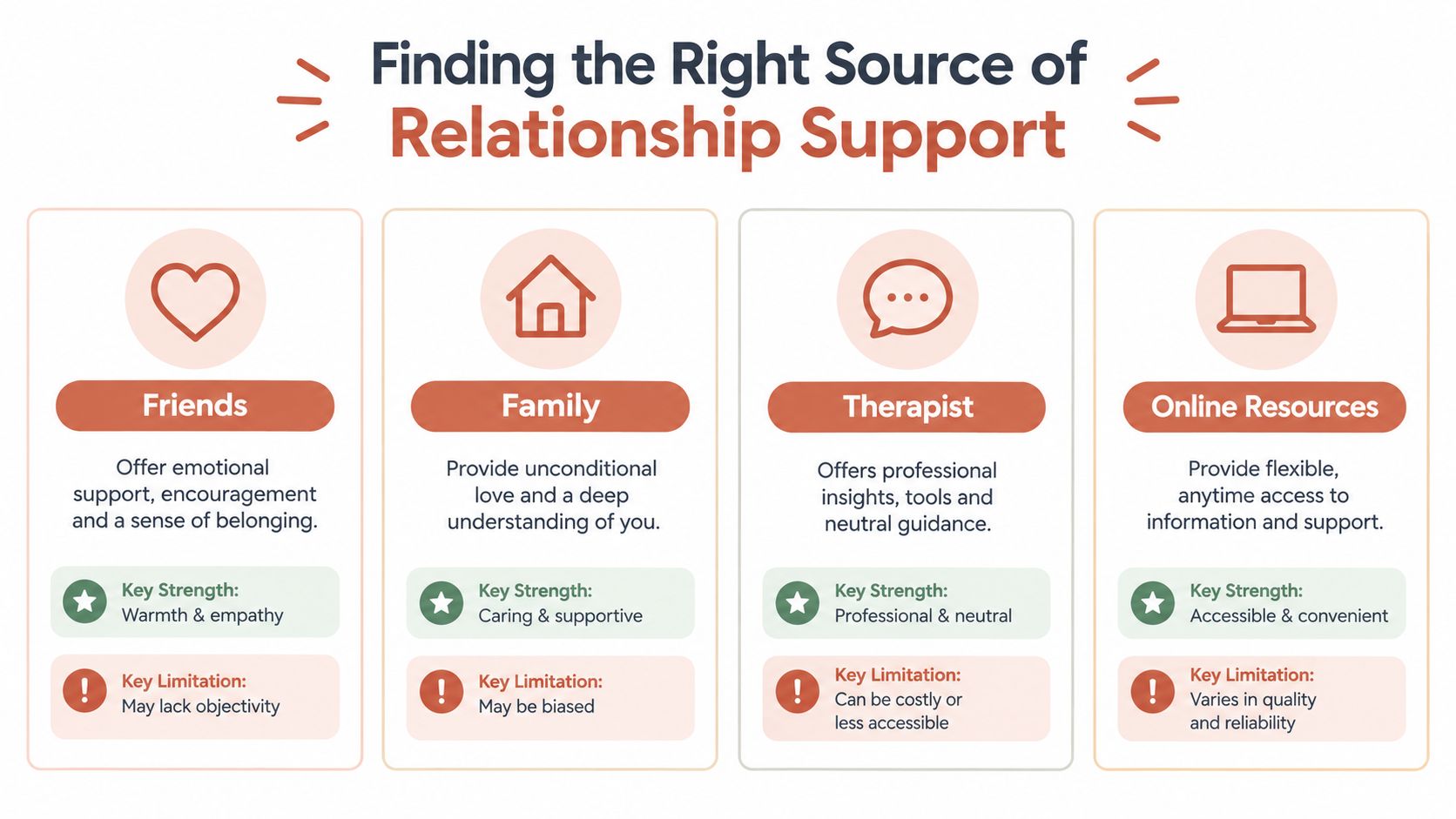
A support matching framework
| Source | Best suited to | Main trade-off |
|---|---|---|
| Friends | Emotional reassurance and remembering personal context | Affection can make objectivity difficult |
| Family | Long-term knowledge and practical support | Relatives may be invested in a particular outcome |
| Therapists | Repeating patterns, conflict, grief, anxiety, or safety concerns | Professional help requires commitment and careful selection |
| Online resources | Private reflection, language for feelings, and preparation | Advice may be generic, contradictory, or poorly qualified |
A useful decision starts with three checks:
- Is the issue private or potentially unsafe? Privacy matters when a partner, family member, or mutual social circle could expose the woman to pressure. Safety concerns deserve a confidential professional or specialist route, not a public discussion.
- Does the problem repeat? A single disagreement may benefit from reflection. A recurring pattern suggests that insight alone hasn’t changed the dynamic.
- Does the adviser have the right role? Friends can listen, but they shouldn’t be expected to diagnose a partner or carry every crisis. A therapist can provide neutrality, but can’t make either partner participate with total openness.
Women can also consider how advice affects agency. The best adviser asks clarifying questions, notices power imbalances, and accepts that the decision belongs to the person living the relationship. The least helpful source pushes a dramatic conclusion without understanding the context.
For readers exploring self-reflection alongside relationship questions, this guide to learning about oneself can help identify values, triggers, and recurring expectations before advice is sought.
Online dating adds a separate trust question. A UK safety study reported that 62% of respondents didn’t think dating-app companies did enough to protect users online, rising to 67% among women, as reported in the UK dating safety statistics overview. That gap makes privacy checks, gradual disclosure, and public meeting arrangements sensible parts of relationship advice for women beginning a new connection.
Practical Communication Strategies That Actually Work
Healthy communication isn’t the same as saying everything at the moment anger appears. It means choosing language that identifies the problem, explains its effect, and gives the other person a fair opportunity to respond. A woman who has repeatedly been told she’s “too sensitive” may need to rebuild confidence in her own observations before she can speak assertively.
Start with a precise message
Passive communication hides the need. Aggressive communication attacks the person. Assertive communication names the behaviour and its impact without surrendering the point.
Instead of saying, “You never care about what I need,” a more useful version is: “When plans change without warning, I feel dismissed. I need earlier notice, even if the plan can’t stay the same.” The second statement doesn’t guarantee agreement, but it gives the conversation something concrete to address.
A practical script has four parts:
- Observation: “When the kitchen is left for me after we agreed to share it…”
- Feeling: “…I feel resentful and taken for granted…”
- Need: “…because shared responsibilities matter to me…”
- Request: “…can the task be completed before bedtime, or can the arrangement be changed openly?”
The request needs to be specific enough to answer. “Be better” creates defensiveness because nobody can act on it. “Please tell me by the morning if plans have changed” creates a clear behavioural choice.
Make listening observable
Active listening isn’t silent waiting for a turn. It involves reflecting the substance of what was said, checking the meaning, and responding to the actual concern. A partner might say, “So the issue isn’t only the missed dinner. It’s that the change was kept from you until the last minute.” That sentence demonstrates attention without automatically admitting blame.
Timing matters too. A conversation is unlikely to go well when either person is rushing, intoxicated, exhausted, or already shouting. A woman can pause without abandoning the subject: “This matters, and the current tone isn’t helping. The conversation can continue after both people have had time to settle.”
A short pause should have a return point. Without one, “later” can become avoidance. A written message can help organise thoughts, but serious emotional subjects often need a real conversation where tone and willingness are visible.
“Clarity is kinder than a carefully disguised accusation.”
People who overanalyse every possible response can use this perspective on overthinking decisions to notice when preparation has become delay. Before speaking, the woman only needs a clear observation, a genuine feeling, and a reasonable request. She doesn’t need a perfect speech.
The conversation also needs reciprocity. If one partner repeatedly explains, listens, repairs, and adjusts while the other mocks, stonewalls, or changes the subject, the problem isn’t merely a communication technique. Better wording can’t create mutual effort where mutual effort is consistently absent.
Setting Healthy Boundaries Without Guilt
A boundary isn’t a demand that controls another adult. It’s a clear statement of what a woman will do to protect her time, privacy, body, emotional energy, or safety. “You can’t speak to me like that” becomes a boundary when it is followed by an action such as ending the conversation and leaving the room.
Guilt often appears because many women have learned to associate care with constant availability. A partner’s disappointment can feel like proof that the boundary was wrong. In reality, disappointment may mean that an old arrangement benefited one person more than the other.
Turn discomfort into a limit
A woman can identify a boundary by finishing this sentence: “I’m no longer willing to…” The answer should describe her own action, not an attempt to manage the partner’s feelings.
Examples include:
- Time: “I’m not available for relationship arguments during work hours. This can be discussed in the evening.”
- Communication: “If shouting starts, I’ll end the call and return to the subject when we can speak respectfully.”
- Privacy: “I won’t share passwords or allow my messages to be checked.”
- Emotional energy: “I can listen for a while, but I can’t be the only source of support for this crisis.”
The wording should be brief. Long explanations invite negotiation over whether the limit is reasonable, especially when the other person has already ignored it.
Consistency matters more than intensity
A boundary works through repetition, not through one dramatic announcement. If a partner mocks a limit, the woman can restate it once, act on it, and avoid defending herself for an hour. The purpose isn’t to win a debate. It’s to make her behaviour predictable.
A boundary also needs a consequence that is realistic and within her control. Threatening to end a relationship when she isn’t prepared to do so weakens trust in her own words. A smaller action, such as taking space, declining a conversation, or changing access to personal information, may be more honest.
Boundaries can’t make an unsafe person respectful. If a partner responds with intimidation, retaliation, surveillance, threats, or isolation, the priority shifts from improving closeness to securing support and safety. This discussion of repeated attraction patterns may help with reflection, but it shouldn’t be used to blame a woman for another person’s harmful conduct.
Healthy boundaries often improve intimacy because both people know what consent, availability, and respect look like. They also reveal an important truth quickly. A caring partner may need time to adjust, but will generally engage with the limit. Persistent punishment for having needs is information, not a communication challenge to solve alone.
Integrating Self-Care Into Your Relationship Routine
Self-care becomes useful when it restores capacity rather than acting as another item on an already demanding list. A woman who has no private time, poor sleep, limited friendship, or no activity that belongs to her may struggle to tell the difference between relationship dissatisfaction and general depletion.
The answer isn’t to retreat from partnership or treat personal wellbeing as a luxury. A stronger routine gives each partner enough emotional space to arrive at conversations with more patience and clearer judgement. It also reduces the risk that one relationship will carry every need for companionship, identity, reassurance, and purpose.

Build a routine that protects identity
A workable routine can be modest. Morning quiet time may mean sitting with a drink before messages begin. Daily movement might be a walk that helps the body release tension. A personal hobby keeps a woman connected to interests that aren’t organised around the relationship.
A weekly check-in gives partners a calmer place to discuss the household, emotional state, and upcoming pressures. Rest without guilt matters just as much. Exhaustion makes ordinary disagreements feel like verdicts, while proper downtime can make the same issue easier to approach with proportion.
The guide to understanding exhausting days can support that distinction between a relationship problem and a capacity problem. The two can coexist, but they don’t always need the same remedy.
Self-care shouldn’t become another form of unequal labour. If a woman must organise every restorative activity, remind her partner about every check-in, and carry the emotional responsibility for keeping both people well, the routine has just added another task to her list. Partners can divide practical work, protect each other’s private time, and ask directly what support is wanted.
A useful test is whether the routine leaves more room for honest connection. If it helps a woman feel more like herself, notice her limits earlier, and participate by choice rather than exhaustion, it is doing its job. If it creates pressure to appear calm while serious problems remain unaddressed, it has become avoidance.
When to Seek Professional Relationship Help
Friends and self-help resources are valuable, but the belief that every relationship problem should be solved privately can delay meaningful support. Professional help becomes appropriate when the same conflict keeps returning, trust has broken down, either partner feels persistently distressed, or conversations produce fear rather than understanding.
UK relationship data indicates the scale of that need. The British Association for Counselling and Psychotherapy report on investing in relationships estimates that 18% of people in adult couple relationships, about 2.87 million people, are in distressed relationships. The report also states that a government-backed evaluation found counselling and relationship education produced statistically significant positive changes in relationship quality, wellbeing, and communication using validated measures.
Choose the right kind of help
Couples counselling can support partners who are both willing to examine interaction patterns. Individual counselling may be more suitable when one woman needs space to process grief, anxiety, trauma, identity questions, or a partner’s refusal to participate. Relationship education and carefully chosen self-help can assist with skills, but they aren’t substitutes for specialist intervention when safety or severe distress is present.
Women shouldn’t wait until a relationship reaches a dramatic breaking point. Professional guidance can provide a neutral structure before resentment becomes entrenched, although it can’t force accountability or make an unsafe relationship safe.
A practical first step is to write down the main concern, the change being requested, and how the partner has responded to previous attempts. That information helps a qualified professional understand whether joint work, individual support, or a safety-focused plan is most appropriate. A woman who feels afraid of her partner should prioritise confidential specialist help and immediate safety over couples exercises.
Relationship advice women can trust should never require them to tolerate harm in order to preserve appearances. Support is working when it increases clarity, choice, and safety, not when it only helps a woman endure more discreetly.
For more practical guidance on relationships, wellbeing, self-discovery, and lifestyle, explore Live Better With. Use the ideas that fit the situation, keep personal boundaries at the centre, and seek qualified support when private reflection or friendly advice no longer provides enough clarity.