Publishing update: This post was scheduled for 7 October, but because junk journaling is trending right now, we’re publishing it immediately instead.
Have you noticed more people saving receipts, ticket stubs and food packaging instead of throwing them away? Perhaps you have also seen videos of torn paper being layered into colourful notebook pages.
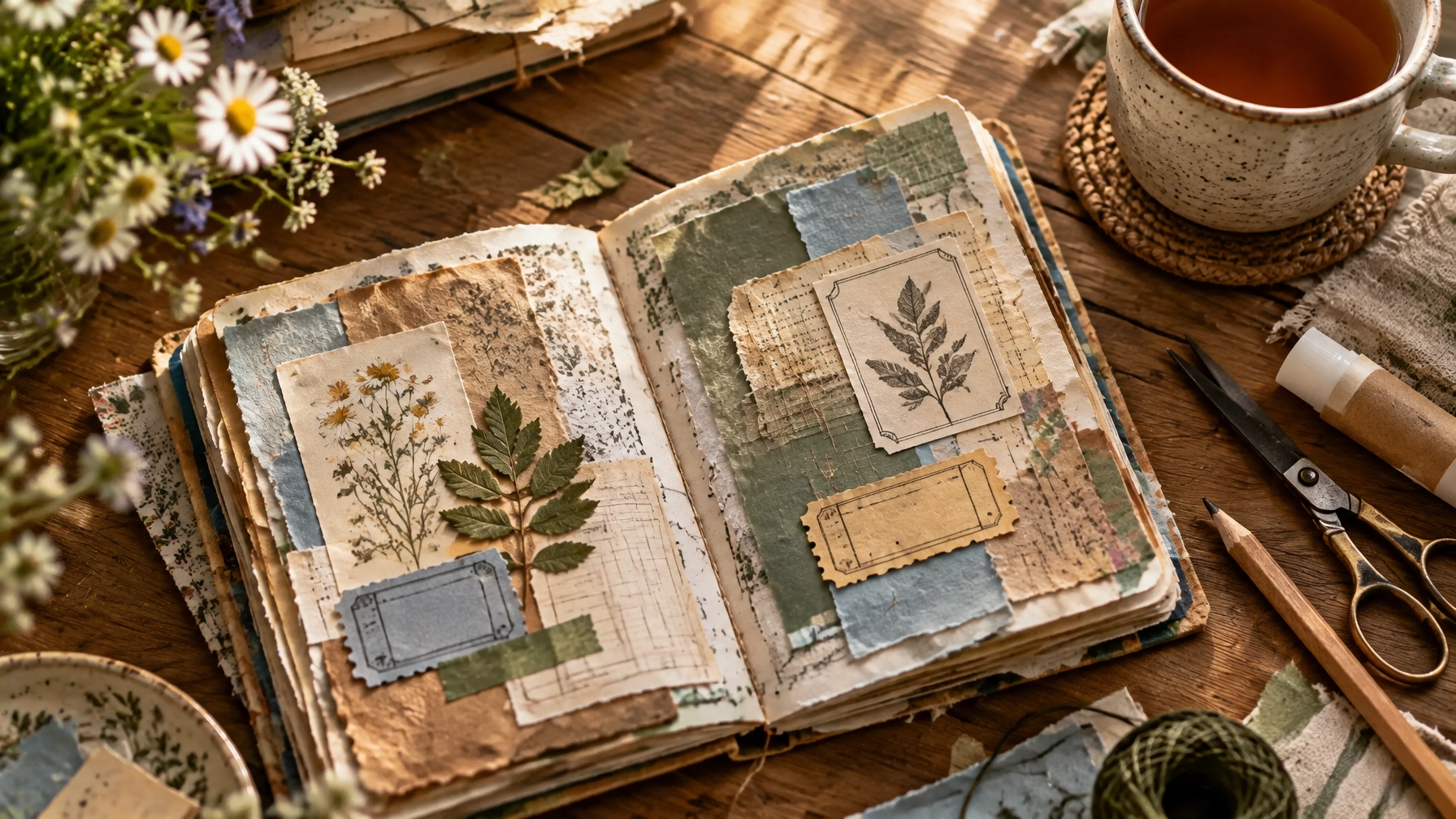
This is junk journaling. It is part scrapbook, part collage, part visual diary, and it is becoming one of the more talked-about lifestyle ideas of 2026.
The phrase “lightly feral” has been used to describe the hobby because it is deliberately untidy, inexpensive and resistant to strict rules. You do not need a perfect notebook, expensive stationery or advanced artistic skills. You might only need a few scraps from the recycling bin and somewhere to stick them.
So why is this simple practice catching on now? We explore how junk journaling connects screen fatigue, creativity, memory, sustainability and mindful living practices.
What is junk journaling?
A junk journal is a handmade or adapted notebook filled with everyday materials. These might include:
- Receipts and tickets
- Food labels and packaging
- Postcards and old envelopes
- Photographs and paper bags
- Magazine cuttings
- Dried leaves and flowers
- Notes, doodles and short reflections
- Stickers, fabric scraps and wrapping paper
There is no single correct format. Some people write several pages of thoughts. Others create mostly visual collages. Some build their own books from folded paper, while others use an ordinary notebook.
The “junk” refers to the humble, often disposable nature of the materials. A restaurant receipt can become a reminder of an evening. A label can hold the colour palette for a page. A ticket can mark a place, a person or a period of life that might otherwise become difficult to remember.
In its recent guide to the trend, CBC Arts describes junk journaling as a book made from found and recycled materials used to collect memories, thoughts, ideas and inspiration.
That combination of freedom and meaning may be part of its appeal.
Why does it feel so “lightly feral”?
Many creative hobbies come with an imagined standard. You might compare your lettering with someone else’s, worry about choosing the right supplies or feel that a page should look finished before it is allowed to exist.
Junk journaling softens those expectations.
A torn edge is acceptable. A crooked photograph is acceptable. An unfinished page is acceptable. You can layer one piece over another, change your mind or leave a blank space without ruining the project.
The “lightly feral” quality is not really about being careless. It is more about removing the need to make everything neat, optimised and presentable. The page can be useful to you even if nobody else sees it.
As Vox recently noted, the abundant and inexpensive materials make junk journaling a low-barrier hobby. The fact that it uses “trash” also brings a playful energy. You are not protecting a costly art kit. You are experimenting with what is already around you.
That can make creativity feel less like a performance and more like a small part of ordinary life.

Is it a response to screen fatigue?
Many of us spend large parts of the day looking at screens. Work, messages, entertainment, shopping and social connection can all happen through the same glowing rectangle.
Junk journaling offers a different pace. Paper has weight. Scissors make a sound. Glue takes a moment to dry. A photograph or receipt can be held rather than scrolled past.
This does not mean that a notebook can solve digital fatigue on its own. It may simply provide a useful change of activity. Instead of reacting to an endless feed, you are choosing one small object and deciding what it means to you.
That kind of attention can feel calming because it is limited. There are no hundreds of new posts waiting underneath the page. There is only the scrap in front of you, the space beside it and the next choice.
For some people, this is one of several mindful living practices that helps create a little separation from the speed of online life. For others, the appeal may be less about mindfulness and more about making something with their hands. Both responses are reasonable.
Why does creativity feel easier when the materials are cheap?
A blank page can feel surprisingly demanding. It seems to ask for a good idea, a clear theme or a finished result.
A page covered in scraps asks a gentler question: what could go here?
When the materials cost very little, the pressure to produce something impressive may decrease. You can try an arrangement, cover it up and try another. You can use a sticker you have been saving for the “right” occasion, even if the right occasion turns out to be a quiet Tuesday.
This is one reason junk journaling may appeal to people who find drawing, painting or traditional journaling intimidating. The creative process begins with selection and arrangement rather than technical skill.
CBC Arts’ guide to collage-based journaling includes a useful suggestion from collage artists: begin with something simple, work from the middle of the book and focus on the process rather than trying to predict the final image.
There is room for intention, but there is also room for surprise.
Can junk journaling support mindful living?
Mindful living is often presented through familiar activities such as meditation, walking, cooking or spending time in nature. Junk journaling fits into the same broader idea, although it is not a replacement for professional support or a guaranteed route to feeling better.
The practice can encourage you to notice small details:
- Which colours keep appearing in your week?
- What objects do you feel reluctant to throw away?
- Which memories are attached to ordinary places?
- What do you keep collecting without realising it?
- What would you like to remember about this particular season?
These questions can make everyday experiences feel more visible. A coffee sleeve, a bus ticket or a note from a friend may not seem important on its own. Placed together, they can show patterns in your routines, relationships and interests.
The act of arranging can also create a short pause between experience and reaction. You might return to a difficult day later, when there is more space to decide what you want to keep from it. Or you might make a page that contains no explanation at all.
The value is not necessarily in producing an attractive object. It may be in giving your attention somewhere steady to rest.

Why are people turning scraps into memories?
Digital photographs are convenient, but convenience can make memories easy to overlook. Thousands of images may sit on a phone without being printed, revisited or connected to a wider story.
Junk journaling creates a physical record. It does not need to be chronological or complete. A page might simply capture the mood of a holiday, the colours of a new home or the small objects connected with a friendship.
A feature from BRICKS Magazine explores how people use scraps to document grief, friendship, anxiety, girlhood and everyday connection. It also describes the way receipts, notes and tickets can become evidence of moments that might otherwise pass unnoticed.
This does not mean every scrap has deep emotional significance. Sometimes a wrapper is just a wrapper. But choosing to keep it can still be a way of saying that a small moment was part of your life.
That is a quietly different attitude from waiting for important events before recording them.
Is it sustainable?
Junk journaling can make use of materials that would otherwise be discarded. This may appeal to people who are interested in low-waste living, upcycling or more thoughtful consumption.
There is a practical limit, though. Collecting every piece of packaging can create clutter rather than reduce it. A mindful approach might involve choosing a small box for useful scraps, recycling anything that no longer has a purpose and avoiding the purchase of large quantities of new materials.
The sustainability benefit is not automatic. Buying lots of decorative supplies to create the appearance of a recycled hobby would tell a different story.
The most interesting part may be the change in perspective: ordinary materials become available creative resources. A paper bag can be used as a background. A food label can become a colour accent. An old envelope can become a pocket for a note.
You decide how far that idea fits your own habits, space and budget.
Could it become a social hobby?
Junk journaling is often a private activity, but it can also create a gentle form of connection. People share scraps, attend craft sessions, exchange pages by post or work quietly alongside one another.
This matters because social activities do not always need to involve conversation, competition or performance. Making something beside another person can offer company without requiring constant attention.
A shared table might include people with very different styles. One person may create a carefully layered collage. Another may add three scraps and a sentence. Both approaches can belong.
The community side of the trend also helps explain why it travels so easily online. Videos may show finished pages, but they also reveal a process that viewers can adapt. There is no single aesthetic to copy and no fixed level to reach.

How could you try it without overcomplicating things?
If the idea is interesting, starting small may be more useful than buying a complete kit.
You could gather:
- An ordinary notebook or a few folded sheets of paper.
- Scissors and glue or paper tape.
- Five scraps that you already have.
- A pen, pencil or coloured pencil.
- A little time without needing to produce a finished page.
You might choose one theme, such as a recent walk, a meal, a colour or a week in your life. Alternatively, you could select materials at random and see what connections appear.
There is no need to begin on the first page. You can work in the middle, leave pages blank or change direction halfway through. If you do not like a spread, it can become the background for another one.
The point is not to create a perfect archive. It is to explore what happens when you pay attention to the things that usually disappear.
So, should you try junk journaling?
Perhaps. The trend is not interesting simply because it is popular. It reflects several ordinary needs at once: time away from screens, inexpensive creativity, tangible memories, gentle social contact and permission to make something imperfect.
For some people, junk journaling may become one of many mindful living practices. For others, it may remain a pleasant way to use up paper on a rainy afternoon. It does not need to become a routine, an identity or another task to maintain.
That may be the most appealing part. You can save the receipt, tear the page, use the sticker and stop whenever you like.
In a culture that often asks us to improve, organise and optimise ourselves, junk journaling offers a smaller possibility: noticing what is already here, and deciding that it is worth making room for.
We explored this trend using recent coverage from Vox, CBC Arts and BRICKS Magazine. For more reflective lifestyle ideas, you can explore Live Better With’s Lifestyle and Self-Discovery sections.